The $10 Ice Cream Cone That Explains Your Classroom
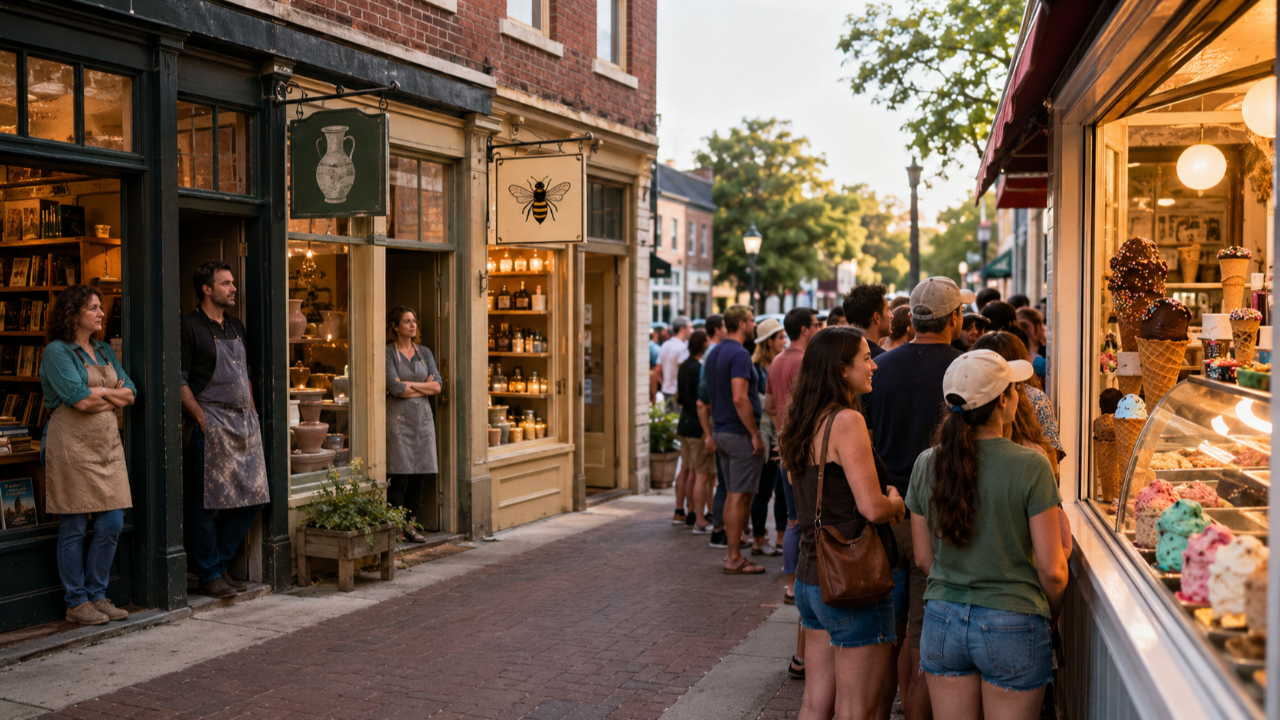
Aug 30, 2026Last week I spent a day in one of those small downtowns you slow down for just to take it all in. Brick storefronts, hand-painted signs, the kind of place where the person who owns the shop is also the person ringing you up.
I went in one by one. A little bookshop. A pottery studio. A shop that sold nothing but honey and candles and things that smelled like somebody's grandmother's kitchen. And every single owner told me some version of the same thing.
"It's been getting harder."
They love what they built — you can hear it in how they talk about it. But they're scared. People's attention is everywhere and nowhere now, they said. The things customers used to stop for, ask about, save up for, nobody seems to care about anymore. Even the FedEx driver said it without being asked: most days now he's delivering to houses, not shops. Everybody wants it right now, at their door, without leaving the couch.
I stood on that sidewalk and felt the weight of it — that quiet fear that what you have to offer just doesn't land the way it used to.
And then I turned the corner.
The line out the door
There was a line. Out the door. In the middle of a slow afternoon on a slow street. It was the ice cream shop.
You could smell it before you could see it. The people in line weren't on their phones — they were talking, about the flavors, about the smell, about the tray of chocolate-dipped everything in the window they couldn't walk past. A cone cost ten dollars, and nobody flinched.
Which is the exact opposite of what every other owner had just told me. They said people won't spend. But that's not it. It's not that people won't spend. It's that they'll only spend on the thing they can feel.
Good isn't a reason to stop anymore
Those other shops weren't losing because their products were worse. That bookshop was gorgeous. That honey was incredible. They were losing because in a world where everything is one tap and one doorstep away, good isn't a reason to stop.
You don't get attention for being valuable. You get attention for being unmissable.
And if you teach, you already know where this is going.
You are the honey shop and the bookshop, standing in your doorway with something genuinely good to offer, competing against a device in every pocket that delivers a dopamine cone every four seconds, for free, without anyone having to get up. And it is so easy to slide into the shopkeepers' fear: maybe they just don't care about this anymore.
That fear is lying to you. Your students didn't stop being able to be moved. They stopped stopping for "good." The bar moved. It didn't disappear.
So the question isn't how do I compete with the phone. You can't, and you'll burn yourself down trying. The question the shop taught me is: how do I become the thing they can't walk past?
Window, Line, Cone
That ice cream shop was winning on three things, and every one of them works on a real Tuesday.
The Window. Lead with a sense, not a sentence. The object on the desk before the objective on the board. The artifact, the sound, the single image, the question written on the door. Something they meet with a sense before their thinking brain catches up.
The Line. Nobody joins a line because a sign told them to — they join because others are already in it. Anticipation and peer pull do what novelty can't. Build one moment worth buzzing about and let students carry it to the next class for you.
The Cone. A ten-dollar cone is worth it because it isn't really a cone — it's a moment they'll tell someone about. Your lesson doesn't need to be entertainment. It needs one peak. Not the whole fifty minutes. One cone.
Before the strategy, the doorway
Here's the part the shopkeepers forgot: before you build the hook and the peak, stand in your own doorway and remember why you opened the shop.
You didn't become a teacher to compete with a screen. You became one because someone once made a moment you couldn't walk past, and it changed everything. You're still that person. Go find that again this week — five quiet minutes, before you plan a thing.
If you want help turning that instinct into practice that's recognized and rewarded, that's the work I do with teachers. If you're beginning National Board, the Component 4 course is where good teaching becomes documented, accomplished, irresistible teaching. If you're renewing, Renew Like a Pro makes a dreaded process feel like the line out the door. Not sure which is yours? Start here.
And the book behind all of this, the reason I saw that shop the way I did, is The Power of Moments by Chip and Dan Heath — the science of why a few experiences stick and most evaporate.
Go make a moment somebody can't walk past.
