
Component 4 Is a Triangle (And Yes, I Actually Love It)
Jul 21, 2026I know. I said it out loud.
I love Component 4.
Say that in a room full of National Board candidates and watch what happens. Somebody's eye starts twitching. Somebody else says, "Tracey, you're crazy." And honestly? I get it. C4 is the component that makes strong, capable, deeply reflective teachers go quiet and start Googling "how hard is it to retake an entry."
But here's why I love it: C4 is so much like the renewal process, and renewal is where I've spent the majority of my coaching for the past nineteen years. Once you see the shape of it — and there is a shape — C4 stops being a swamp and starts being a plan.
It took me a while to wrap my mind around it too. So let me give you the visual that finally made it click, both for me and for hundreds of candidates since.
Because Component 4 is a triangle.
(If you've watched me talk about Component 3, you know that one's candy corn — my upside-down triangle. This one's a slice of pizza. I make no apologies for how much of my coaching runs on food metaphors.)
The three corners
Picture a big triangle. Now let's label the corners.
Top corner: your group profile and your unit of study. Who are these students, really, and what are you going to teach them because of who they are?
Bottom left corner: your PLN — your professional learning need. What do you need to grow in?
Bottom right corner: your SLN — your student learning need. What do they need?
Now here's the kicker, and this is the part that surprises almost everybody:
These three corners do not have to relate to one another.
They can be completely, explicitly different. Your group profile and unit can go one direction, your professional learning need another, and your student learning need somewhere else entirely. That is allowed. That is fine. That is, in fact, what most of the candidates I work with end up doing — all three of their corners look nothing alike.
Or they can all connect and speak to each other beautifully.
You're in charge of this component. That's the amazing part. And there is nothing I love more than watching a creative teacher sit down and figure out how to match all three corners of that triangle. When it works, it's gorgeous.
But it is not required. Please hear me on that, because I've watched too many candidates burn three weeks trying to force a connection that didn't need to exist.
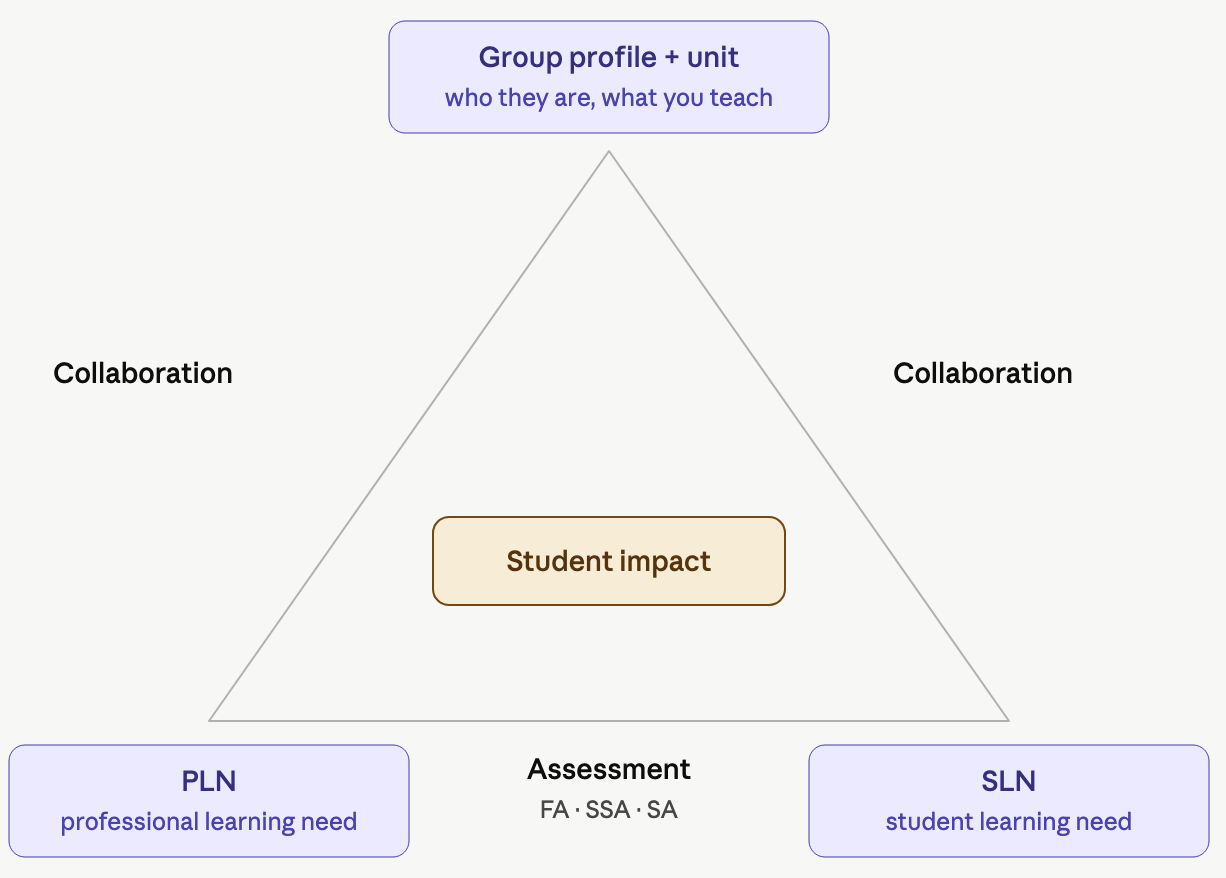
"The Component 4 triangle: group profile and unit at the top, PLN
and SLN at the bottom corners, collaboration along both upper sides,
assessment along the bottom, student impact at the center."
The sides of the triangle: what actually holds it up
Corners are one thing. But a triangle is held up by its sides, and this is where C4 lives or dies.
Side one and side two: collaboration
Run your finger from the top corner down to your PLN, and from the top corner down to your SLN. Both of those sides are collaboration.
Collaboration is not a nice-to-have in this component. It is load-bearing.
The assessors need to know that you have gone outside the four walls of your classroom. That your work extends into your grade level, your school community, and the community your students actually live in — which absolutely includes parents, families, guardians, and caregivers. And when you can show collaboration at the district or state level, even better. But you have to prove it. Naming it is not proving it.
That same expectation lives up at the group profile corner, too. How did you come to understand who these students are? Last year's teacher. The teacher before that. The school nurse. The guidance counselor. The mental health counselor. The gifted and talented teacher. The EL teacher. The parents. The guardians. The list keeps going.
Because the group profile and the unit are intertwined: you collaborate to figure out who these students are, and then you decide what unit of study will meet the needs you discovered.
So whether your PLN and SLN match each other or not — and again, they don't have to — both must show collaboration. That's the glue.
Side three: assessment
The third side of the triangle is what I affectionately call FA, SSA, and SA.
- FA — formative assessment
- SSA — student self-assessment
- SA — summative assessment
That's the wall that holds C4 up on the other side. And you can't just have the assessments; you have to show us how you used them. How assessment took you from identifying the need, to designing the unit, to knowing whether anything actually changed.
In the world of National Board, we know that assessment drives instruction. So show the drive. The needs surfaced in the group profile. The unit grew out of those needs. Formative assessment told you where students were. Students self-assessed along the way. Summative assessment closed the loop.
And here is the single hardest part of this component for most teachers:
Showing growth on specific skills between the formative and the summative.
Not "the students enjoyed the unit." Not "engagement improved." Growth, on identified skills, that a stranger reading your entry can see. That's the piece I spend the most coaching time on, and it's the piece most often left thin.
Lead with needs
If you take one phrase out of this whole post, take this one.
Lead with needs.
Say it again. Needs. Needs are everything in C4.
At the top of the triangle, you collaborate to discover the needs.
At the bottom of the triangle, you collaborate to meet the needs.
Along the assessment side, you measure whether the needs were met.
That's the whole architecture. It's the same rhythm as renewal, which is exactly why this component feels like home to me.
The four questions for your PLN and your SLN
Here's the second visual, and it applies to your professional learning need and your student learning need alike. Grab a piece of paper and work it out for yourself.
Put the need in the middle. Then answer, in order:
- What is the need?
- Who did you collaborate with?
- What did you learn from that collaboration?
- How were students impacted?
That fourth one is not optional and it is not a footnote. Student impact is the whole point. How were students impacted by your collaboration and by what you did with what you learned?
Which means we can go back to the triangle one last time and write the ultimate goal right in the center:
Student impact.
On all three sides. Every corner. Everything you submit should be pointing at it.
So what makes it a beast?
Honestly? Not the thinking. The thinking is the triangle, and now you have the triangle.
It's the evidence. Loads and loads and loads of evidence. It's assembling your PDFs, managing the uploads, and wrangling the submission system without losing your mind or your files. It's staring at a folder of artifacts at 11 p.m. wondering whether any of it actually says what you meant it to say.
And it's that one thing I mentioned earlier — showing growth on identified skills between the formative and the summative. That's where I see strong entries go soft. Not because the teacher didn't do the work. Because the work never made it onto the page in a form an assessor could score.
That's exactly what I built my Component 4 coaching around.
Inside the C4 course, you get:
- The triangle framework fully unpacked, with planning visuals for every corner
- Structures for documenting collaboration so it proves rather than claims
- A step-by-step approach to the formative-to-summative growth story — the piece that sinks the most entries
- Evidence organization guidance, so your uploads tell one coherent case instead of a pile of attachments
- My Video Vault, free inside every course
One retaken entry costs $475. This costs a fraction of that, and it's built to keep you from needing the retake in the first place.
Get inside the Component 4 Course
Not sure C4 is where you need support? Come find me at https://www.traceybryantstuckey.com/initial — I've got courses for every component, MOC renewal programs, and 1:1 coaching through the All-Access Pass. Nineteen years, roughly four hundred candidates a season. I'd love for you to be one of them.
