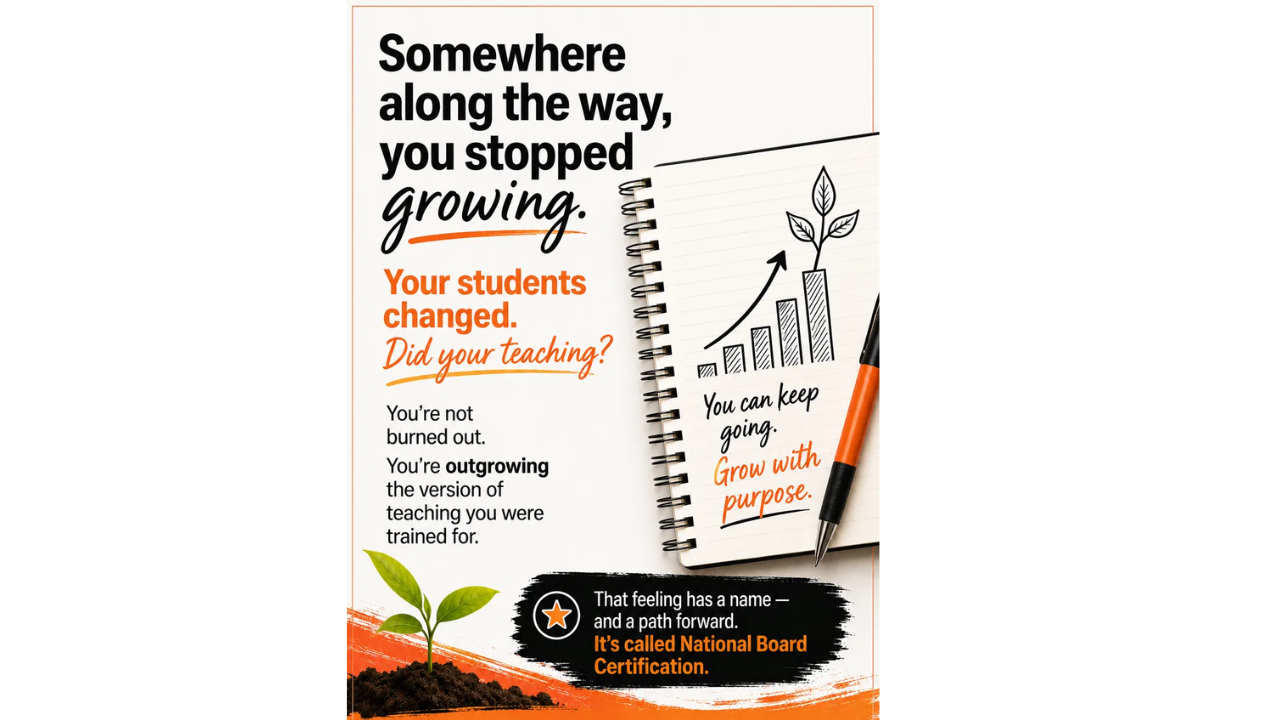
Somewhere Along the Way, You Stopped Growing
Jul 01, 2026You didn't stop loving teaching. But something about it stopped feeling the way it used to.
The behaviors in your classroom look different than they did five years ago. The workload hasn't gotten lighter — if anything, it's heavier, with more to track, more to document, more coming at you before the bell even rings. And some days, the strategies that used to work for you just don't land the way they once did.
It's tempting to read all of that as a sign something's wrong with you. It isn't. It's feedback. Your students are showing you, in real time, exactly where your practice is ready to grow next. The heavier load, the harder behaviors, the moments where your old playbook falls short — none of it is working against you. It's pointing you somewhere.
That's not burnout. Burnout feels like exhaustion rest can fix. This feels more like outgrowing a version of teaching you were trained for — while still loving the work itself.
Your Students Changed. Did Your Teaching?
Here's the truth nobody hands you in a staff meeting: the students in front of you today are not the students your degree was designed around. The way they think, attach, communicate, and engage has shifted — and it keeps shifting. Every fall brings a slightly different classroom than the one you mastered the year before.
So if you've found yourself wondering whether you're still good at this job, here's a reframe worth sitting with: you're not failing. You're not behind. You are a teacher who has simply outgrown the toolkit you were handed years ago, and nobody ever told you that growing out of something isn't the same as falling short of it.
It's actually a sign of something good. It means you care enough to notice. Teachers who've truly stopped caring don't ask these questions at all.
That Feeling Has a Name — And a Specific Other Side
That quiet tug — the sense that you're capable of more, that there's a version of your practice still waiting to be found — that feeling has a name. But naming it isn't enough, and growth is too vague a word to walk toward. So let me tell you what the other side of it actually looks like, in specifics, because you can't move toward a future you can't picture.
Picture a Tuesday next spring. Third period walks in — the group that's been your hardest all year. Months ago, that class made you doubt yourself; you tried harder, cycled through strategies, hoped something would land. This Tuesday is different — and not because the kids changed. It's different because you can see, in real time, why the lesson is or isn't working, and you adjust on purpose instead of on instinct and a prayer. You used to make good moves without knowing why they worked. Now you can name them. And what you can name, you can do again on purpose.
That's the shift. Small on the surface, enormous underneath.
The Sunday-night question — am I still good at this? — gets quieter, because you've stopped guessing. You've held your own practice up to a rigorous standard, made a hard instructional call, put words to the reasoning behind it, and watched it hold. That's not a feeling anymore. It's evidence, and it's yours. Meanwhile the newer teacher down the hall starts asking how you handled something — because your expertise has finally become visible enough for someone else to learn from. And the restlessness you walked in with, the one sending you to job boards and half-read grad-school tabs, quietly resolves. Not by leaving the classroom. By going further into it than you knew was still there to go.
None of that comes from another binder you'll skim once and shelve. It comes from a process built to point a light at what you're already doing — to name it, give it structure, and hand it back to you sharper than you knew it was.
That's what National Board Certification really is, underneath the word "credential." It's the rare kind of professional growth that doesn't swap your toolkit for someone else's. It takes yours apart piece by piece, shows you what you've quietly become, and — in much of the country — asks your state to put that recognition on your paycheck, too.
You're Allowed to Want More
If any of this is resonating, let it be information, not guilt. Teaching is one of the few professions where loving the work and wanting more from it get treated like a contradiction. They aren't. Wanting more for your practice, your students, and your own sense of purpose is the same instinct that made you good at this in the first place.
So here's the honest next step — not a leap, just a look. You don't have to decide anything today. You only have to be willing to see the teacher that Tuesday-in-spring is already describing: the one standing in your room right now, one process away from being able to name everything she knows.
See whether this is your season for it at www.traceybryantstuckey.com/Is-this-for-me
