What If You're Closer to the Bar Than You Think?
Jul 09, 2026You have questions. That's the first thing I want to say to you, because most people won't.
You have a running list — maybe not written down, but you carry it. Why did that lesson work for third period and fall flat for fifth period? What is it about this group that the strategy that's never failed me suddenly isn't reaching? Is that kid actually behind, or is he bored, or is something happening at home, or is it all three? Am I doing this right — not right for the evaluation, right for them? You ask yourself these things constantly. Most of the day, honestly, you're not delivering content. You're reading symptoms and forming hypotheses. You feel less like an educator some days and more like a diagnostician — someone standing in front of twenty small mysteries, trying to figure out what each one needs.
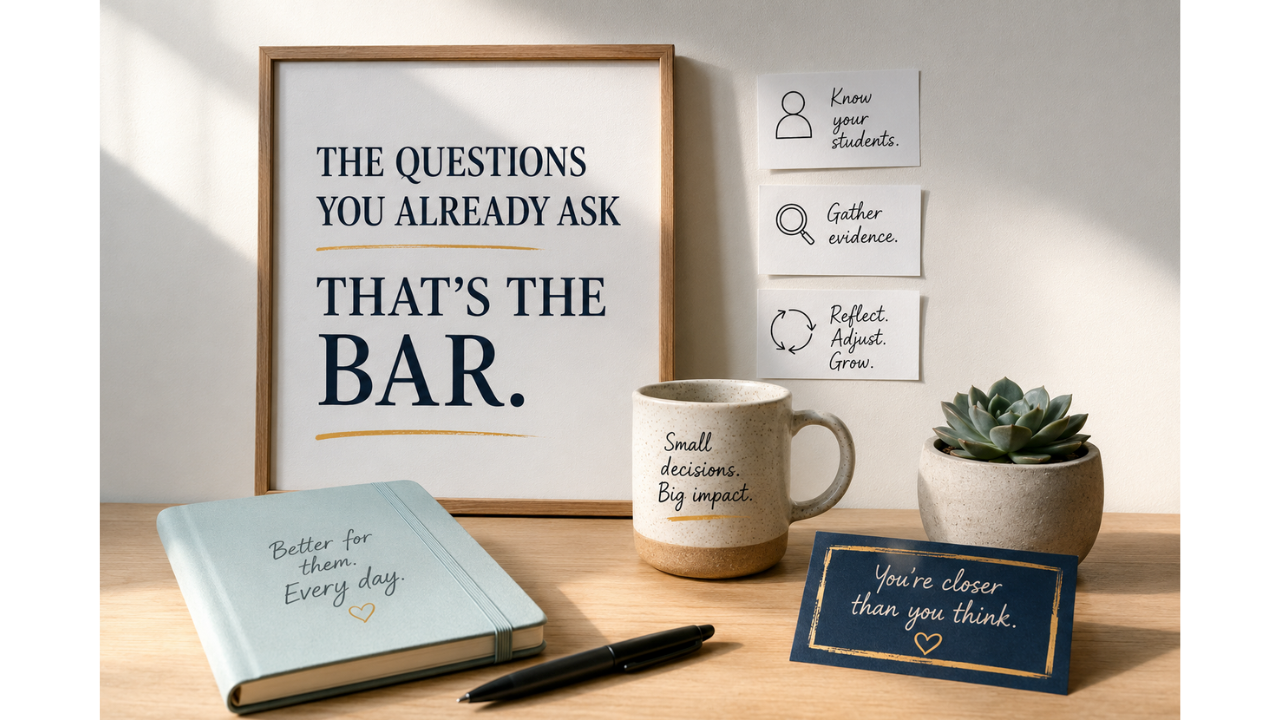
Here's what I want you to hear: that questioning isn't a sign you're falling short of the bar. It is the bar.
Because somewhere along the way, "the bar" got explained to you backward. You were led to believe National Board's standards are a ceiling hung high above your head — a list of things excellent teachers do that you'd have to climb up and reach. So you look up, you see the distance, and you think not me, not yet, maybe never. But that's not what the standards are. Read them honestly and you'll notice something strange: they're not describing tricks you don't have. They're describing the questions you already ask. The standard about knowing your students? That's the mystery you're already trying to solve every period. The standard about assessment? That's you, reading symptoms all day. The standard about reflecting on your practice? That's the running list you carry in the car. The bar isn't above you. It's a mirror held up to the questions already keeping you curious.
Which means the distance between you and certification is smaller than you've been told. You're not missing the questions — the hardest part, the part that can't be taught. You're just missing the process that answers them.
And that's what this actually is. Not a test that judges whether you're good enough. A structured way to finally answer the questions you've been carrying alone. When you write about a student in a National Board portfolio, you're not performing for a scorer — you're doing, on paper, the diagnosis you do in your head, except this time you slow it down enough to see it. Why did this work? Who did it work for? What does the evidence say I should do next? You've been asking those questions at 70 miles an hour on the drive home. Certification is the process that pulls over, turns off the radio, and lets you actually answer them. Candidates say the same thing again and again: it didn't just credential their teaching, it explained it to them. The questions they'd carried for years finally got answers — in their own words, from their own practice.
So let me hold up the flashlight, not to show you a bar you can't reach, but to show you how close you already are to it. The distance you feel isn't a skills gap. It's an unnamed gap — the space between doing excellent, diagnostic, question-driven work and having ever seen yourself do it. That gap doesn't close by learning to be a better teacher. It closes by finally looking.
You're closer than you think. Not because the bar is low — it isn't — but because you've been quietly clearing it for years while staring at the sky, convinced it was still above you.
When you're ready to stop wondering and start answering — to turn all those questions into practice you can finally see clearly — I'd love to walk it with you. You're nearer the bar than anyone's ever told you. Let’s take this journey together - www.traceybryantstuckey.com.
